
“Phalloplasty isn’t just one thing” — former RFF phalloplasty patient interviewed for this project
This resource relies on database and hospital document research, interviews with patients who have undergone racial forearm-flap phalloplasty and medical professionals who work with people during and after RFF phalloplasty. Former RFF patients will be referred to as “interviewees” or “clients.” Medical professionals will be referred to by their medical title [doctor, PA, OT, etc]. Any information included in this resource has been anonymized for the comfort of the interviewees/medical professionals involved.
Welcome! If you’re here on this website, it’s because you are interested in learning more about supporting people after radial forearm-flap (RFF) phalloplasty, about the RFF phalloplasty process, or about occupational therapy after RFF phalloplasty. This educational tool has five modules focused on different topics related to occupational therapy after RFF phalloplasty; you can navigate to different modules using the bar at the top of the website. This page is a tool to help you understand how the modules are structured; this page explains where the information to make the modules came from and can direct you to other sources. Any medical term or procedure mentioned will be linked out; websites and articles have been vetted for quality of information.
Welcome to part one of the module: what is RFF phalloplasty? This page will focus on the radial forearm-flap phalloplasty procedure; what it can look like, what it can entail, and what clients may go through during the procedure.
Overview of the RFF phalloplasty procedure
What follows is an overview of the main component of the RFF phalloplasty procedure; that is, the creation of the neophallus (this module will use this word throughout; as you can imagine, it means “new penis,” and refers to the creation of a penis where there previously was not one, either for gender-affirming reasons or due to genital trauma) from a skin flap taken from the radial forearm.
Phalloplasty typically includes other procedures, which happen in different surgical “phases;” however, because the surgery is very customizable, patient experiences and component surgeries are not universal. The one universal component is the neophallus creation from the forearm skin. Component surgeries will be discussed further along in the module. Below is a visual representation of the neophallus creation procedure, to keep in mind while reading the description.
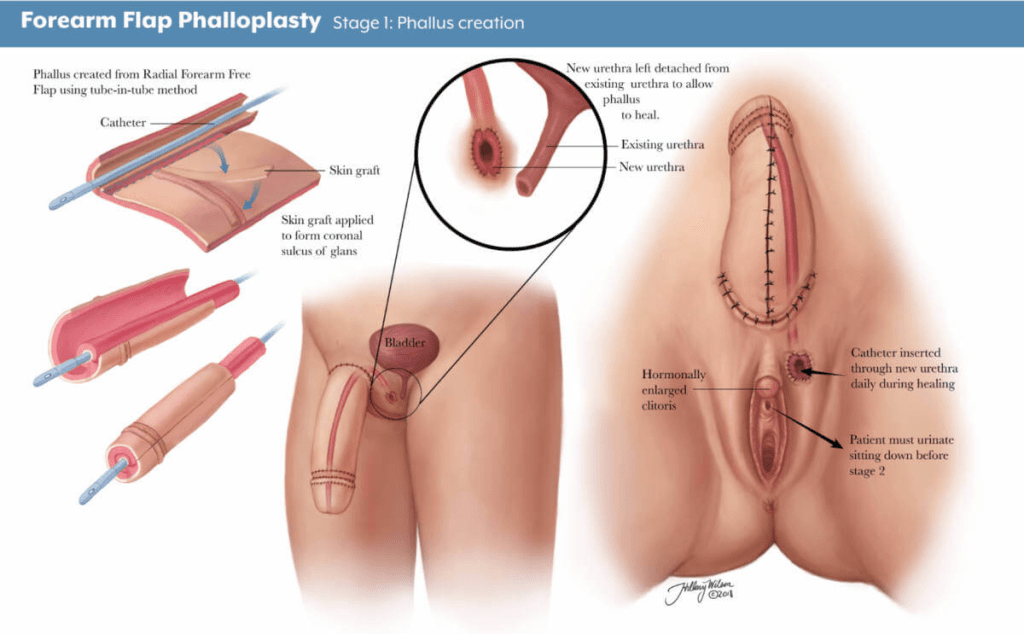
(source: John’s Hopkins University)
The central component of RFF phalloplasty is is the creation of a neophallus primarily using skin from the radial forearm; radial forearm skin is frequently used for skin flaps because it is thin and flexible. During surgery, the fasciocutaneous free flap (a flap that contains skin, subcutaneous fat, and fascia — and is free because it is completely detached from its original blood supply and reconnected via microvascular anastomosis to recipient vessels at the reconstruction site) is dissected from the forearm at the level of the muscular fascia. An illustration of the flap can be seen here:
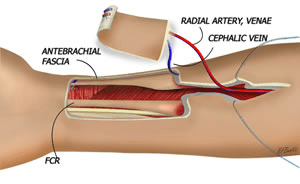
(Source: Phallo.net)
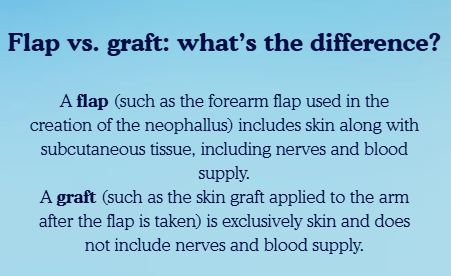
Skin grafts can be either be split thickness (not containing the whole dermis) or full thickness (containing the whole dermis). Both are used at different points in the RFF process.
After its removal, the radial forearm flap is then used to form the neophallus. The formation occurs apart from the body, and the neophallus will then be attached to the body. The radial forearm flap varies in size depending on surgeon technique and can be up to six inches long. and will be wrapped around a skin tube, which will eventually connect to the urethra (this process is known as urethral lengthening, and ensures that the patient will be able to pee through the neophallus). This is known as the “skin-tube” urethra; its creation is sometimes referred to as “tube within a tube” (TWT), as the skin tube made from the radial forearm is wrapped around a tube made of local genital tissue (which will become the new urethra). During surgery the patient will have a catheter; that is why you see a blue tube in the artist’s illustration shown earlier.
After its creation, the neophallus is then attached to the body via microvascular anastomosis to recipient vessels at the reconstruction site. During stage two of phalloplasty, the neophallus is attached to the body via a process known as anastomotic urethroplasty; this is the connection of the lengthened urethra to the native urethra. Some clients choose not to receive urethral lengthening. This is typically because urethral lengthening leads to the two most common complications in RFF phalloplasty, which affect 10 to 20 percent of patients; urethral stricture (the narrowing of the urethra) and fistulas (the unintended contact of the urethra with the skin, causing urine to exit at an unexpected spot). One of the interviewees for this project suffered from too many fistulas and chose to undo his urethral lengthening; he reported that the only difference is being unable to urinate through the neophallus and instead peeing through his native urethra.
During “phase one” surgery, different institutions handle the radial forearm site differently. At some sites, it will be covered with Integra (a skin substitute) during healing; it will then be covered with a wound vac to speed up the healing process. In a second procedure, a split-thickness skin graft (typically from the thigh, but occasionally from the buttocks) will be taken and used to cover the radial forearm site. This typically happens a few weeks after “phase one” surgery.
At other hospital sites, the split thickness skin graft can be taken and used to cover the radial forearm site during stage 1, and there is no need for Integra.
The neophallus created during surgery is capable of developing erogenous sensation. The nerves typically used in this process are 1-3 antebrachial cutaneous nerves to the clitoral nerve and ilioinguinal nerve, meaning that the entire neophallus has the ability to acquire erogenous and tactile senses. If clients receive urethral lengthening, they can also use it to urinate. Clients who choose to have an erectile implant inserted in a later surgical phase can also get an erection.
As mentioned earlier, after phase one surgery, clients typically receive several follow-up surgeries in subsequent phases. Because many of these surgeries are optional and the process is very customizable, the process can look different for each patient. The next section of this module will discuss further surgery phases and the procedures that can occur during them.
For those interested in learning more of the technical aspects of this procesure, this video of a phalloplasty procedure shows the removal of the arm flap beginning at 3:17; only watch it if you aren’t squeamish).
Other surgeries that may be a part of RFF phalloplasty
If this module gives you one core takeaway, let it be that “radial forearm-flap phalloplasty” is not just one procedure. It can include a variety of procedures, happening during different surgical “phases.” Most RFF phalloplasties occur in three phases.
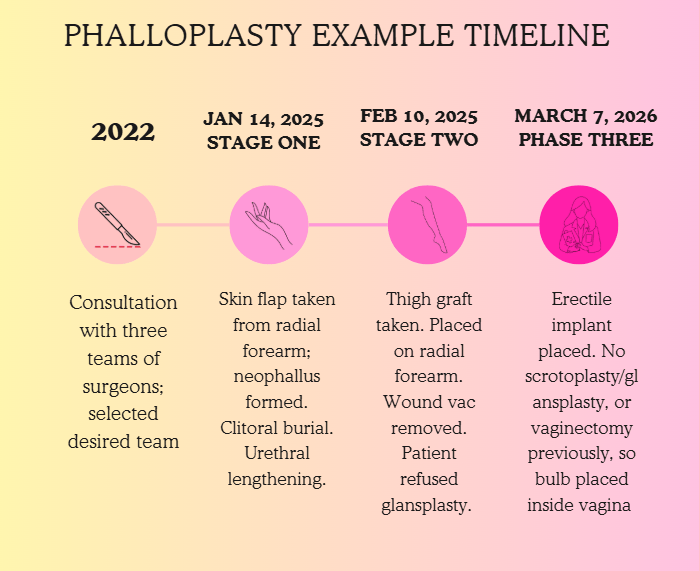
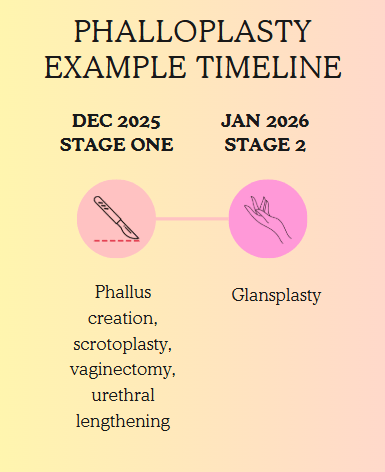
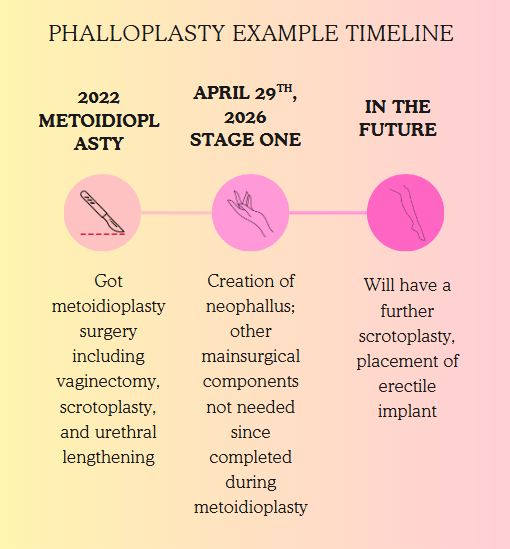
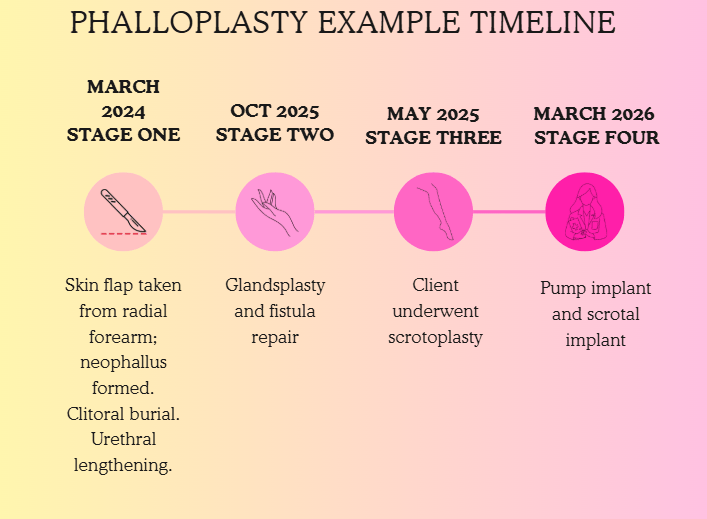
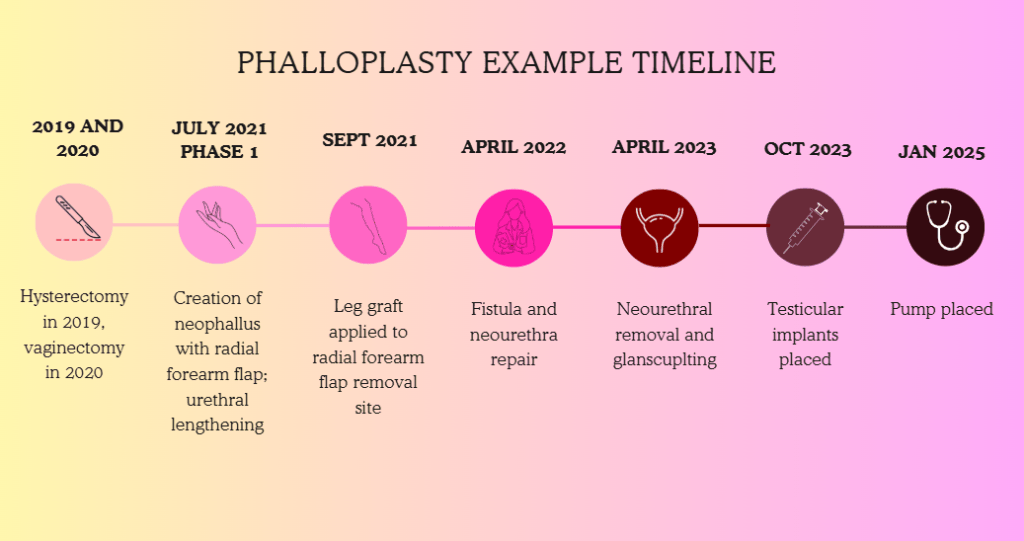
From an occupational therapy perspective, it is most common to have occupational therapy and other therapy services (usually physical therapy) after Phase One of RFF phalloplasty. This is because the creation of the neophallus (and therefore the removal of the wrist flap) always happens in Phase One.
Procedures that can be a part of RFF phalloplasty
Electrolysis/hair removal: Clients need to undergo hair removal on the radial forearm before RFF phalloplasty. This is because hair on the skin flap can cause issues with the neophallus, including fistulas or urethral blockages (the two most common complications). This can begin as early as one year prior to surgery.
Vaginectomy: A vaginectomy is the removal of all or part of the vagina. In the case of phalloplasty, it is a gender-affirming procedure, though it can also happen due to cancer or other conditions. Not all clients get a vaginectomy during their phalloplasty.
Urethral lengthening: As mentioned previously, urethral lengthening is the creation of a new urethra in the neophallus using a skin tube (the tube within a tube method). Not everyone gets this procedure due to the complications that can arise.
Mons resection and panniculectomy: A mons resection is the removal of fat from the mons pubis via liposuction; a panniculectomy is the removal of extra skin. Both of these procedures optimize the placement of the penis on the pelvis.
Scrotoplasty: Scrotoplasty is the building or rebuilding of a scrotum. In transgender patients, this is done using existing labia tissue and a silicone testicular implant.
Insertion of erectile device: Typically the last stage of phalloplasty surgery, an erectile device allows the new phallus to get and hold an erection during sex. During this procedure, the erectile device is inserted into the neophallus, and the pump for the device is placed into one of the scrotal pockets; a testicular implant is typically inserted into the other scrotal pocket. If clients do not get a scrotoplasty, their pump can be placed in the mons fat. The erection is achieved by activating the pump by squeezing it several times, which moves the saline in the pump into the penis to cause the erection. To drain the erection, bend the penis down and the saline will drain back into the pump. Patients also have the ability to choose a malleable implant if they would like, which can be manually pushed up or down.
Metoidioplasty: Metoidioplasty is a form of gender-affirming bottom surgery that uses already-existing genital tissue to construct a phallus. The resulting phallus will be a few centimeters long. The surgery typically involves surgically releasing the clitoris, then covering it with skin from the labia. Some patients get only metoidioplasty; other clients move on to get other forms of phalloplasty after. This surgery typically also involves urethral lengthening (meaning clients will be able to use the neophallus to urinate).
Glansplasty: Glansplasty is, essentially, the creation of a rounded penile head on the neophallus, giving the neophallus a circumcised appearance.
These are the main surgeries that occur as a part of the RFF phalloplasty process. Next, let’s discuss complications that can arise.
Complications that arise from RFF phalloplasty
There are a variety of complications that can arise from RFF phalloplasty. As previously mentioned, fistulas and urethral strictures are the most common complications that occur during phalloplasty, with ten to twenty percent having one or the other. Here is a list of other complications. This list is not comprehensive; it draws mainly from a few academic studies (Complications Following Gender-Affirming Phalloplasty: A NSQIP Review; Donor Site Morbidity in Phalloplasty Reconstructions: Outcomes of the Radial Forearm Free Flap; Predictors of Major and Minor Complications following Phalloplasty) and from surgeon and hospital websites (any used will be linked).
Arm weakness after skin grafting: Clients can face weakness or decreased sensation in the radial forearm after removal of the flap and placement of the skin graft. OT intervention often focuses on rebuilding this strength in the arm and hand, as well as sensory integration.
Lymphedema: Swelling of the arms and legs — clients are often given compression garments for the arm to reduce the occurrence of lymphedema.
Skin graft failure: Failure of the flap (neophallus) to adhere to the body, or healing issues with the flap or graft site. Often caused by infection and considered a medical emergency that requires quick intervention.
Neuroma: A neuroma is a complication that can come from swelling of nerves at the radial forearm site. Because many nerves are harvested in the donor flap that becomes the neophallus (to allow sensation in the neophallus), there can be nerve complications or morbidity at the forearm site.
Donor site nerve pain: Similarly, clients may face nerve pain in the arm after RFF phalloplasty. In a survey of 37 patients, 31 reported nerve pain after surgery.
Hematoma: Hematoma is essentially severe bruising due to blood vessel trauma; it usually resolves on its own and does not lead to complications, though it should be monitored by the patient’s team to ensure it is not serious. Serious hematomas may need to be resolved through an additional surgery.
This is not a comprehensive list, but it does cover several of the most common complications.
Interactive case studies
Every module will include interactive components for providers who want to practice or test their knowledge. They will typically be at the end of the module. The characters included in the case studies, and their backgrounds, are listed here. Here are your case studies for part one:
Case Study One

Case Study Two

You have reached the end of Part One! Congrats. For Part Two: Patient Experiences and Needs, click here. To find more sources and resources about RFF phalloplasty and for a full list of sources, click here.
 Functionality after Phalloplasty