
“Anyone can put a Pride flag in a window, but that doesn’t mean that this person has training or this is necessarily a safe space.” — Interviewee from the study “Conceptualizing trans-inclusive healthcare in the United States: Environmental and interpersonal factors of healthcare provision”
Welcome to part four of Functionality After Phalloplasty: how to be a trans affirming provider.
This unit will begin with a case study.
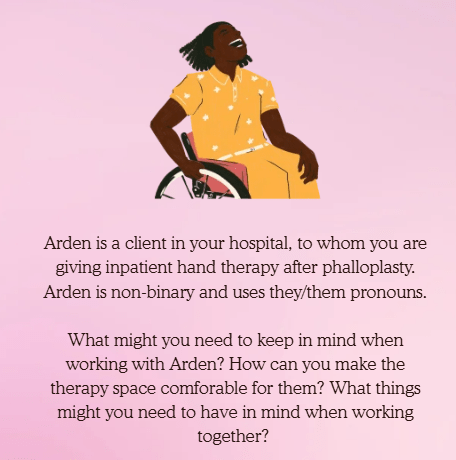
With this case study in mind, let’s get started.
This module will include information gathered from talking to trans clients who have had phalloplasty, clinicians who work with clients after phalloplasty, from online trainings about trans competency in healthcare, and from academic articles about trans competent healthcare. The module will end with links to a variety of online trainings about working with trans patients for anyone who is interested in learning more.
People of many different genders get phalloplasty
People get phalloplasty for lots of different reasons — in fact, not everyone to gets phalloplasty is transgender. Cisgender phalloplasty occurs when trauma or injury has happened to the phallus, necessitating creation of the neophallus. This is to say, it’s a good idea to throw assumption out the window when working with clients after phalloplasty.
Some things to keep in mind:
People get phalloplasty who do not identify as men; they may identify as non-binary, genderqueer, or something else.
People getting phalloplasty may have partners of any gender.
Approach your clients with respect, curiosity, and a willingness to learn about their lives.
There are a variety of “best practice” tips for working with trans clients in inpatient and outpatient medical care settings. Here are just a few that are relevant to gender-affirming surgery:
Name and pronouns are important
Clients will feel valued and respected if you call them by their correct name and pronouns. It is important to remember that the client’s name in your electronic medical record may not be the name they go by. This can be because their legal name is not the name they go by, or because the name on their insurance differs from their legal name. Either way, it is crucial to call the client by the correct name and pronouns. You can ask the client how they like the be referred to; do not assume information on their armband or in their profile is correct unless that has been verified.
Don’t ask questions you don’t need the answers to
It can be tempting to ask the client questions about their surgery or their experience of gender when you are working together; however, interviewees who had previously gotten phalloplasty said they disliked feeling like they had to explain the surgery or their experiences as trans people to their providers. It can also make clients feel uncomfortable if they are asked too many personal questions. A good rule of thumb is to stick to questions you strictly need the answers to (i.e, when did the client get surgery? What exercises have they been doing during their inpatient stay?). If you have technical questions, check to see if an online resource (like this website) has the answers before asking the client. Generally speaking, it is considered inappropriate to ask clients questions about their gender or pronouns (i.e., “So you got this surgery but you use they/them pronouns?”). This may seem obvious, but clients often face these kinds of questions and report discomfort. Research shows they may even avoid care due to questions or exams that have been violating in nature.
Wear a pin/badge, introduce yourself with pronouns, etc
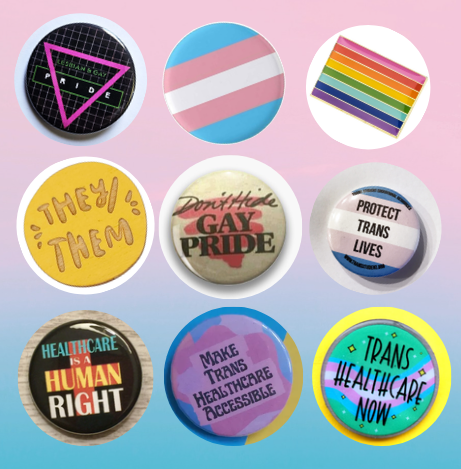
Many hospitals have initiatives in which staff wear lanyards with pronoun pins or LGBTQ+ flag pins to show that the hospital is LGBTQ+ friendly. Although it is not sufficient to provide these pins without training staff on LGBTQ+ cultural competence, they are a simple visual way to show clients that you are interested in creating an inclusive environment. Many RFF phalloplasty clients reported being more comfortable with a therapist when the therapist was either openly LGBTQ+ identified or showed themselves to be LGBTQ+ friendly in another way (such as with a pronoun pin, rainbow lanyard, etc).
Is your paperwork/signage inclusive?
Trans patients mention inclusive paperwork as one of the factors that makes them feel welcome in healthcare spaces. It is worth thinking about the intake forms at your own clinic; do they have a space for clients to list an alternate name (if their name differs from their legal name)? Do they include a space for pronouns? Are you you using gender neutral language regarding partner(s)? Instead of asking for assigned sex (e.g., male/female), can you ask specific questions (e.g., “do you have a uterus) that are relevant to the work you are doing? Similarly, eliminating gendered bathroom signage or gendered terminology related to the clinic (i.e., “women’s health”) is another way to make your environment more inclusive.
Just training and environmental changes are NOT enough — cultural change matters!
If you ask clients for the name they prefer and then call them by their previous name, or wear a trans flag pin but ask your trans patients invasive questions, this is known as an inclusive environment with exclusive behavior. Although the environment has been changed to indicate friendliness to LGBTQ+ patients, the clinic culture has not changed to follow it. The cultural changes are what will make or break the LGBTQ+ patient experience — they matter! A patient interviewed for a 2025 study said, “Anyone can put a Pride flag in a window, but that doesn’t mean that this person has training or this is necessarily a safe space.” Ask the hard questions about your environment and work to make it truly equitable and inclusive.
Consider standards in your profession for trans healthcare
Your profession may have specific standards related to trans healthcare that providers are expected to follow; this is a great place to start when creating clinical guidelines or trying to make your own personal practice more trans competent. The JAMA clinical guidelines are a great place to start for any medical professionals interested in learning standards for trans care. For occupational therapists, AOTA has a toolkit for working with trans and gender-diverse individuals.
Trainings for healthcare workers
If a healthcare worker using this module is interested in learning more, they are several high-quality trainings to consider. Here are just a few of them:
- The National LGBTQIA+ Health Education Center offers several trainings, webinars, and other resources for free
- Nurse Journal has aggregated a variety of continuing education LGBTQ+ trainings for nurses; some may be of interest to OTs and other healthcare workers as well
- Affirmative Services for Transgender and Gender Diverse People: Best Practices for Frontline Healthcare Staff is a free resource available to anyone that healthcare workers can use to deepen their knowledge of LGBTQ+ healthcare
- Massachusetts Department of Public Health offers a variety of LGBTQ+ competence trainings for continuing education free of change
If you have reached the end of the module, that means you are done with this training website (yay!). Thanks for being here and wanting to learn more. Continue on to part five if you are looking for further resources, or for a full list of the sources used to create this website.
 Functionality after Phalloplasty