
“There was a difference between what I would have liked to have gotten and what I got” — quote from an RFF phalloplasty patient interviewed during this project
This resource relies on database and hospital document research, interviews with patients who have undergone RFF phalloplasty, and medical professionals who work with people during and after RFF. Former RFF patients will be referred to as “interviewees” or “clients.” Medical professionals will be referred to by their medical title [doctor, PA, OT, etc]. Any information included in this resource has been anonymized for the comfort of the interviewees/medical professionals involved.
Radial forearm-flap (RFF) phalloplasty recovery is complex and occurs over a period of months, if not years. Clients go through a variety of therapies and recovery experiences in this process.
This section of this education tool was created using conversations with people who had formerly had RFF phalloplasty surgery. Those interviewed had surgery at a variety of different hospitals across the United States and Canada; they had different individual surgeries as a part of their RFF phalloplasty course, different caretaker situations, and different accesses to therapy. Their feedback, experiences, and opinions have been summarized here. Thank you to all of the interviewees, who gave of their time because they wanted to contribute to OT education and availability of resources about RFF phalloplasty.
OT access after phalloplasty
Access to therapies after phalloplasty varies widely based on several factors; availability of therapists in the area where one lives, insurance coverage, surgeon recommendations, and so on. Some clients received months of therapy after surgery, including inpatient and outpatient therapies; others received a handful of therapy sessions, mainly inpatient. Some clients had access to several therapies, including pelvic floor PT/OT, OT hand therapy, postsurgery PT, and OT specifically for wound care or scar massage; others received only hand therapy and PT after surgery. Clients who received more therapies tended to report higher satisfaction with their care; clients with limited therapy often reported concerns about their functional outcomes.
Many clients reported “wraparound” services that involved inpatient and outpatient therapy from the same hospitals. Others reported seeing outpatient therapists at a different facility than their surgery took place at. Clients who received wraparound services tended to report the most satisfaction because they felt that their therapists were knowledgeable about the surgery.
Patient comfort with providers
Some clients who had outpatient therapy at a different facility commented that they felt uncomfortable discussing the procedure with their outpatient provider or felt like their outpatient provider wasn’t familiar with the procedure. Some patients expressed interest in a handout or message that they could give to their outpatient provider that explains what happened to their hand and wrist without “outing” them as trans to the provider; find an example message to send to send to a provider in the resources page.
There were several factors that clients reported helped them feel more comfortable with their hand therapist. One factor was if the hand therapist was openly LGBTQ+ identified. The second was if the therapist was openly LGBTQ+ positive or affirming, for example if therapists wore pins with pronouns or rainbow/trans flag pins or showed in other ways that they were LGBTQ+ friendly. The last was if the therapist was associated with the hospital where they got surgery and was familiar with the procedure and saw many clients who had gotten RFF phalloplasty.
Patient recovery in OT
Most clients return to full wrist functionality, although interviewees often reported that they were slightly reduced in their ability to extend their wrist. Two clients reported some difficulty doing push-ups.
Clients reported concerns about returning to a variety of activities that involved the hands. Playing guitar, working on their car, knitting and crocheting, working out, weightlifting, typing on a computer, and returning to work tasks that involves hands were activities clients mentioned worrying about being able to resume. Interviewees typically reported being able to resume simple ADLs with minimal assistance within a few weeks. All interviewees reported that they had been able to resume the reported activities within a month, with the exception of weightlifting and more “heavy” exercise work like pushups. One client mentioned that after nine weeks of recovery, he was able to go back to the gym, so resuming such activity may take longer than less strenuous activity like fiber crafts.
A provider spoken with for this project mentioned that clients sometimes face depression or low mood after surgery because they are recovering from home in a slow process and not able to socialize or engage in their desired activities the way they do at baseline. A study focused on this can be found here; here is a resource with practical suggestions and supports for people experiencing depression after surgery.
Every client I spoke to reported more comfort in their body and happiness after their surgery. The surgery is typically highly anticipated, and clients have often been on a waitlist for a while. One client mentioned waiting for six years to get RFF phalloplasty; another mentioned waiting for two years. They all expressed emotions around the surgery like joy and relief, as well as an increased quality of life post surgery.
Other Ways OT Might be Utilized
A few interviewees shared ideas for ways that OT might be used after RFF phalloplasty that it is not being used currently. Four suggested ways are listed here:
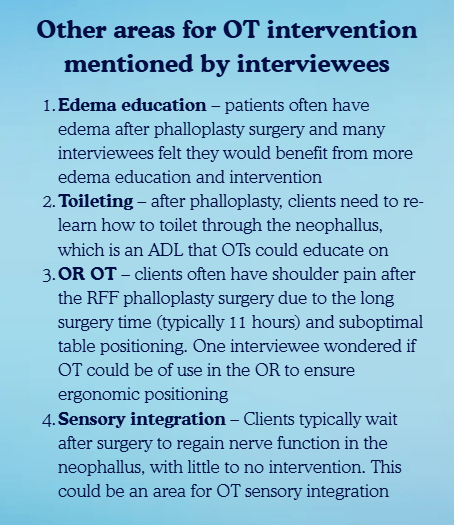
These are offered as food for thought for OTs; how are our skills currently being incorporated into gender-affirming care? What are ways they might be incorporated in the future? It is also worth considering the ways clients are affected by this lack of services. I.e., a client who does not undergo sensory integration of the neophallus may struggle to gain sensation. OT could play a role in the healing process that could greatly enhance quality of life after RFF phalloplasty (functionality of the neophallus correlates significantly with higher QOL scores).
List of supplies that patients mentioned finding helpful in recovery
Interviewees were mixed on whether they had access to a list of supplies that would be useful to have during recovery; a few mentioned that they did not have access to one, but would have liked to. This is a list of supplies aggregated from the interviews:
- Shower chair: Useful during recovery, as standing may be painful due to thigh graft and patient may feel fatigue. One client specifically mentioned using a transfer bench due to ease of use.
- Scalp brush for shower: Helps wash hair when one is only able to use one hand during early recovery
- A few clients mentioned liking a recliner for recovery since it was not possible to bend at the waist in recovery
- Some patients mentioned that having a bidet was helpful when they were recovering; if one cannot be installed, a squeeze bottle bidet can be useful
- Patients need a cast cover when showering in the early days after their flap removal, to cover the wound
- Patients may find a donut pillow useful after surgery if they have had a vaginectomy; some patients mention pain when sitting
- A few patients mentioned finding a bedside commode useful in the early days when pain made it hard to move
- A removable shower head is useful when recovering since only one hand can be used in the shower
- Safety strips in the bathtub can help assure patients do not slip in recovery (honestly, these are a good idea for everybody!)
- Teeth can be brushed from bed in the early days of recovery; toothpaste pellets may be useful for this task
- Some clients mentioned needing an arm pillow in recovery to rest their arms
- A bed desk can use useful in the recovery phase; clients mentioned enjoying one that can be moved up or down as needed
- Some clients mentioned enjoying a phone stand during recovery since they only had one hand for using their phone
- Grabbers to be used when one is unable to bend over
- Wet wipes can be useful when one is unable to shower in the early days after surgery
Caregiving needs after surgery
Patients tend to need care for at least a few days after surgery, if not a few weeks. Here are some details to keep in mind regarding recovery and caretaking:
Clients may be following a variety of surgical precautions; for example, clients are unable to bend at the waist for a period of time after surgery because it will restrict bloodflow to the neophallus. Many clients report finding standing and walking painful, due to the skin graft taken from the thigh; conversely, some clients find sitting painful.
Clients who have limited caregiving are able to set themselves up for success during surgery by eliminating tasks that require bending at the waist. Clinicians recommend putting needed supplies for cooking and other tasks on the countertop ahead of time so they are ready post surgery and other similar adaptations.
Loose end note: Clients mentioned that because they no longer have a radial artery (the artery is taken with the flap and become spart of the neophallus), they no longer have a radial pulse on the arm the flap is taken from. One client also mentioned that it is difficult to have blood taken from that arm and he asks providers to use his other arm.
Similarly, clients lose sensation on the back of their thumb due to irritation of the radial nerve. Clients benefit from education around these losses — interviewees mentioned that it calmed them to know what was normal to expect.
Case Studies
Here are your case studies for this unit. A resource that might be interesting as you think through case study two is Lifestyle Redesign for Gender Affirmation.
Case Study One
Case Study Two
You have reached the end of module two. Congrats! For module three (rehabilitation after RFF phalloplasty), click here.
 Functionality after Phalloplasty