
This resource relies on database and hospital document research, interviews with patients who have undergone RFF phalloplasty, and medical professionals who work with people during and after RFF. Former RFF patients will be referred to as “interviewees” or “clients.” Medical professionals will be referred to by their medical title [doctor, PA, OT, etc]. Any information included in this resource has been anonymized for the comfort of the interviewees/medical professionals involved.
This section will focus on rehabilitation strategies after radial forearm-flap (RFF) phalloplasty.
Rehabilitation after RFF phalloplasty is a process that, much like RFF phalloplasty itself, occurs in many steps and can look different for every patient. This difference depends on individual surgeries the patient may have gotten, what therapies and rehabilitation strategies are recommended by the surgical team, what the healing process looks like for the individual patient, and other factors. This module includes a variety of strategies that may be included, but it is not comprehensive. Rehabilitation after phalloplasty often involves occupational and physical therapies, as well as other forms of care including visiting nurses and home caregiving.
Rehabilitation may be done differently at different hospital or outpatient sites. Clients may receive different types of therapy after surgery; in interviews with clients who received surgery at different hospitals throughout the United States and Canada, no one therapeutic experience was the same. Postsurgical therapy can include occupational therapy intervention related to ADLs, physical therapy intervention related to mobility, and hand therapy intervention related to functionality of the hand and wrist after skin grafting.
This module will group therapeutic strategies broadly by type (i.e, splinting, hand exercises), then address different exercises or strategies clients and providers mention using after surgery. This is by no means a one-to-one, direct guide on best practices after surgery; it is an amalgamation of information from different providers. If a technique is mentioned, there will be a link to a scholarly article or medical text on the efficiency or proven clinical use of the tactic for those interested in learning more.
First things first: make intervention occupation based! In an ideal world, occupational therapy should focus on activities that are important to the client. Clients who were satisfied with their post-RFFP occupational therapy typically reported that the therapist focused on activities that were of interest to them and incorporated those activities into the session. One interviewee reported that his OT asked him at the beginning of outpatient therapy if there were any activities he was eager to return to or focus on; the therapist then focused the bulk of the therapy in the last few sessions on these activity. The client felt this allowed him to see how much he had grown, as well as showing him that his interest were a priority.
If activities the client is interested in can be centered, the client will ideally have higher buy-in and more interest in completing the exercises, even when difficult.
With that in mind, let’s move on to more technical specifics.
Splinting: The flap source site on the radial forearm tends to be wrapped or splinted after surgery, over the wound vac placement. The splinting varies depending on provider. For example, some people interviewed wore a hard splint after surgery and were told not to bend their wrist for a period of time (times mentioned by interviewees varied from two to six weeks) while their graft site was healing. Other interviewees mentioned that they never wore a hard splint; these clients said that their arm was given a compression sleeve, then wrapped in a compression bandage (read an academic article about compression wrapping after skin grafts here to learn more). Clients who were bandaged and not given a hard splint were given no restrictions on wrist movement. One client who works in the medical field mentioned waking up from the hospital and immediately checking to see if he could still bend his wrist, because he was nervous about regaining function.
There is research suggesting both methods are effective and beneficial in different situations; overall, the choice seems up to surgeon or therapist preference and clinical knowledge. The body of work available on this subject is vast; those interested can learn more at these links (usefulness of surgical glove dressing; to splint or not to splint; wrist immobilization of RAFF donor site).
Hand exercises: Inpatient and outpatient therapists typically utilize a hand exercise regimen to assist in healing after RFF phalloplasty. Hand exercises help increase strength and mobility during the healing process. A variety of hand exercises can be beneficial in the healing process; hand exercises will be chosen using the professional judgement of the therapist. With that said, here are examples of exercises mentioned by therapists or patient interviewees spoken to for this module.
“Tabletop” or “six pack” hand exercise: This is a common exercise to build strength and increase mobility in the hand; it also allows for tendon release. It works by keeping the ligaments, capsule and tendons of the fingers moving normally. Watch a video of the exercise here to get an idea of how to do it; this illustration also demonstrates the exercise.
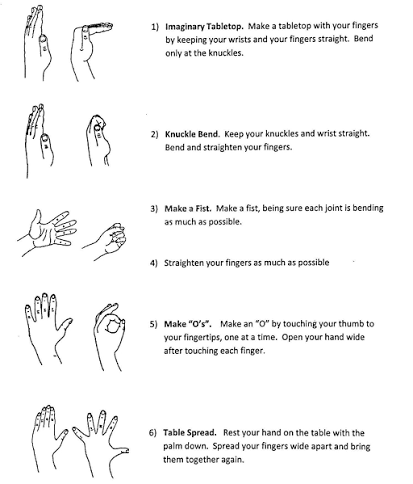
(Source: East Bay Hand Medical Center)
Finger opposition: Touch each finger to the thumb, then go back again in the other direction. This motion should be familiar to most OTs because it is a developmental milestone for young children.
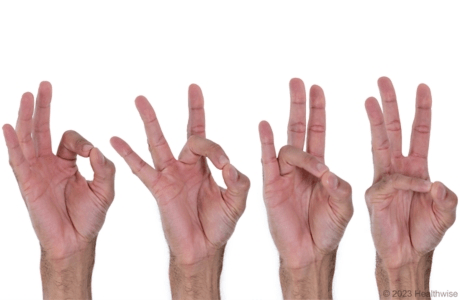
(Source: MyHealth Alberta).
Marble manipulation: Some interviewees mentioned doing exercises with marbles during their hand therapy sessions to improve strength and dexterity. Ideas for marble-based hand therapy exercises can be found here and here.
Theraputty exercises: Theraputty is often used during hand and wrist rehabilitation. An excellent and very thorough guide to Theraputty exercises can be found here.
Forearm curls: Forearm curls are exercises that engage the wrist and forearm, specifically the wrist flexors. Read this article to learn some ways to incorporate them into hand therapy after RFF phalloplasty.
Wrist rotation: Wrist rotations are a way to “warm up” the wrist before completing other exercises. Here are some resources on wrist rotations: Dynamic Warmup: Wrist Rotations from The Special Olympics, Assisted Wrist Rotations).
Full-arm mobility exercises: Full-arm mobility exercises ensure continued mobility in the arm, wrist, and hand during the healing process. See a handout focused on full-arm exercises here, and a video demonstrating some exercises here.
Strengthening with weights: Clients mentioned to me that some therapists had incorporated weightlifting into their exercise routines near the end of their rehabilitation. This typically occurred with one or two-pound weights and was for the purpose of strength building. research suggests that ability to lift is correlated with a successful return to work after surgery or injury. This is also a good way to incorporate the client’s interests if the client enjoys working out or weightlifting, which multiple interviewees mentioned as an interest.
Hand bicycle/upper body ergometer: Upper body ergometers are a method to build endurance and strength in one’s muscles after surgery or injury. See a video of how they work here.
Resistance bands: Resistance bands are used in a variety of hand therapy exercises for strength and endurance building. Read more about the theory behind them and some potential here, and watch a YouTube video to learn some hand exercises using a resistance band here.
Picking up pegs/beads: These are classic OT activities that encourage fine motor dexterity in the hand and wrist. Variations on this can include picking beads out of Theraputty or other similar activities.
This is just a sampling of the exercise options. OTs should use their professional judgement to create an ideal routine for each client.
Scar massage: OT after surgery can also involve scar massage. Scar massage can aid in the recovery process by moving collagen fibers to speed up healing. This breaks up scar tissue and can prevent the scar from becoming hard and raised. Read an academic article on the purpose of scar massage here. Learn some scar massage methods here. These methods can be taught to patients and caregivers so they can be done at home.
Similarly, OTs may help with other forms of wound care. One interviewee reported that his hand therapist was the one who removed his stitches and monitored hematomas, as well as monitoring edema in the hand. Another mentioned that their OT introduced them to using medical honey on their arm as it was healing. Another client mentioned their OT performing lymphedema massage.
Surgical precautions: Surgical precautions can vary based on surgeon (for example, when a client is able to resume bending the wrist), however there are some precautions that are fairly universal. For example, clients cannot lift with the wrist where the flap was taken from for a period of time after surgery when it is healing. A common surgical precaution is that clients are not able to bend at the waist for a length of time after surgery. This is because bending at the waist can lead to restriction of bloodflow to the neophallus. This can make it more difficult to complete a variety of ADLs, including cooking, cleaning, and so on. This also means that clients cannot drive for the length of time they are unable to bend and are unable to sit up in bed at a 90-degree angle. This often leads to back pain, especially in clients who have a history of back pain, which may affect their ability to engage in OT and PT after surgery.
Clients also need to keep the neophallus propped up for a period of time after the surgery, which affects their engagement in a variety of occupations. For example, clients must prop up the neophallus with their hand during showering, meaning they only have one hand to complete showering tasks.
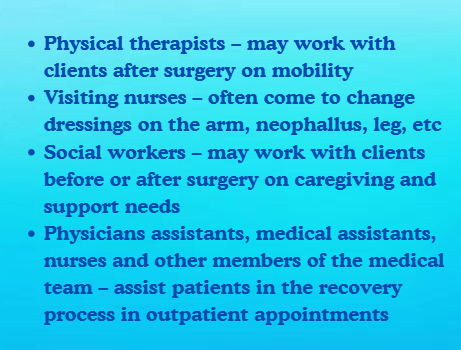
Other therapies clients may receive: Clients recieve other therapies after RFF phalloplasty and may be working with other professionals, including:
Case Studies
Here are the case studies for this unit:
Case Study One
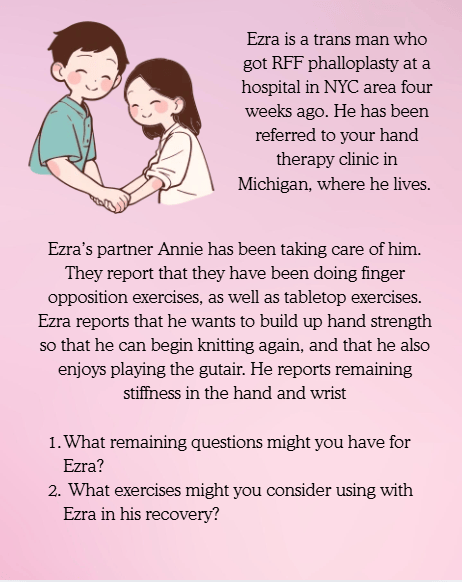
Case Study Two
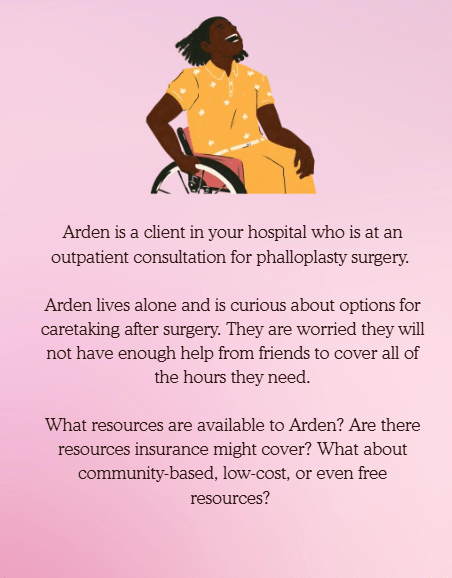
You have now reached the end of module three. To continue learning, move on to module four, “How to be a trans affirming provider.”
 Functionality after Phalloplasty